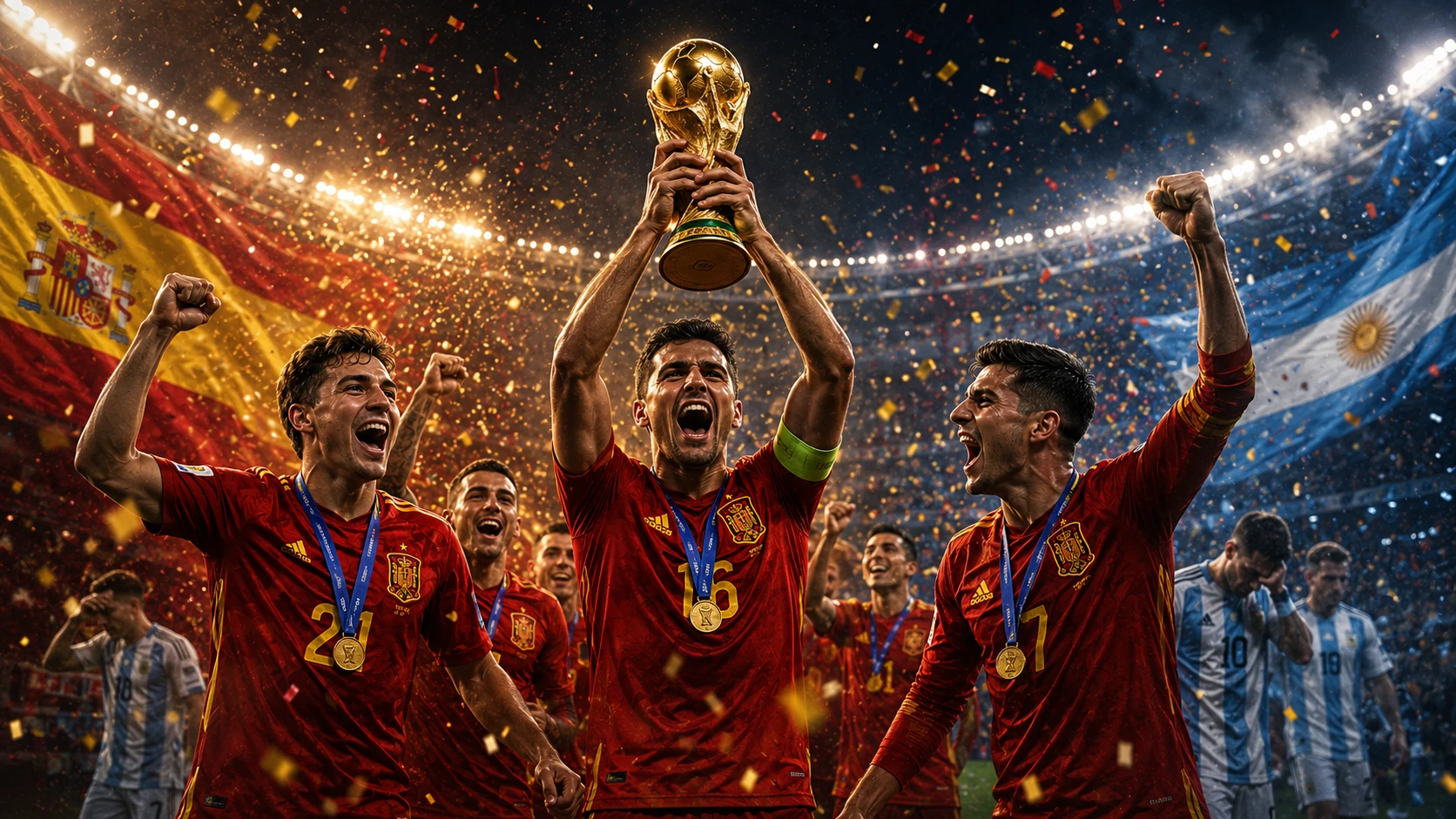
Spain are world champions for the second time after beating Argentina 1–0 following extra time in the 2026 FIFA World Cup final.
Ferran Torres scored the only goal in the 106th minute, finishing from close range after Nico Williams headed the ball into his path. It was the breakthrough Spain had spent almost two hours trying to find against an Argentina side reduced to 10 men following Enzo Fernández's dismissal in stoppage time.
The scoreline suggests a narrow contest. The match itself was not.
Spain controlled possession, produced 20 shots to Argentina's two, registered 12 attempts on target while allowing none, and finished with an expected-goals advantage of 1.94 to 0.22.
Argentina defended, disrupted and delayed, but rarely threatened. Their first shot did not arrive until the 117th minute. Lionel Messi, potentially playing his final World Cup match, was restricted to one off-target attempt and spent most of the evening isolated from dangerous areas.
It was not the spectacular final many had hoped for after a tournament filled with goals. It was tense, fractured and often confrontational. Yet the winner was deserved.
Spain entered the tournament as our number-one rated team. Eight matches later, they left New Jersey with the trophy, seven clean sheets and a defensive record no previous men's World Cup champion has bettered.
Spain 1–0 Argentina: Match Summary
| Detail | Information |
|---|---|
| Competition | FIFA World Cup 2026 final |
| Result | Spain 1–0 Argentina |
| Status | After extra time |
| Half-time | 0–0 |
| Full-time | 0–0 |
| Goal | Ferran Torres, 106 minutes |
| Assist | Nico Williams |
| Red card | Enzo Fernández, 90+3 minutes |
| Date | Sunday 19 July 2026 |
| Venue | New York New Jersey Stadium, East Rutherford |
| Attendance | 80,663 |
| Referee | Slavko Vinčić |
Spain had waited 16 years for another appearance in the World Cup final and 16 years for a second title.
Argentina arrived attempting to become the first team since Brazil in 1962 to retain the trophy. Instead, their reign ended without a shot on target.
The Winning Goal
The decisive moment arrived one minute into the second period of extra time.
Nico Williams, introduced from the bench, attacked the space inside Argentina's penalty area and directed a header across goal. Ferran Torres reacted quickest, collecting the ball before powering a close-range finish beyond Emiliano Martínez.
It was a goal created by Spain's depth.
Neither Torres nor Williams had started the final. Both were introduced as Luis de la Fuente looked for greater directness against an Argentina side defending increasingly deep with 10 players.
Williams immediately stretched the pitch and forced Argentina to defend wider. Torres occupied the central spaces that had become increasingly difficult for Mikel Oyarzabal to access.
The combination finally created the opening Spain had been threatening throughout the match.
Torres' finish was only Spain's 14th goal of the tournament, a modest total compared with Argentina's 19. But Spain had never needed a prolific attack. Their defence ensured one goal was enough.
Enzo Fernández's Red Card Changes the Final
Argentina's resistance was weakened in the third minute of second-half stoppage time.
Fernández, already booked for dissent, launched into a late challenge on Pau Cubarsí and received a second yellow card.
The dismissal reflected Argentina's increasingly confrontational approach.
They had spent long periods breaking Spain's rhythm through fouls, disputes and physical challenges. Four Argentina players were booked during the match, while Spain completed the final without receiving a yellow card.
The red card did not create Spain's dominance. That had existed throughout the match. It did, however, remove one of Argentina's midfielders just as extra time began and made their attacking limitations even more severe.
With Fernández gone, Argentina dropped deeper. Messi and Julián Álvarez became isolated, while the defending champions relied almost entirely on Martínez to keep them level.
Spain eventually made the numerical advantage count.
Spain Dominated Every Major Metric
Spain's advantage in total shots during the 2026 World Cup final.
Shots on target. Argentina did not test Unai Simón once.
Spain's share of possession as they controlled the ball and territory.
| Match statistic | Spain | Argentina |
|---|---|---|
| Possession | 65.1% | 34.9% |
| Expected goals | 1.94 | 0.22 |
| Total shots | 20 | 2 |
| Shots on target | 12 | 0 |
| Touches in opposition box | 32 | 8 |
| Goalkeeper saves | 0 | 11 |
| Corners | 9 | 4 |
| Successful final-third passes | 214 | 38 |
| Total passes | 853 | 464 |
| Pass accuracy | 89.4% | 76.9% |
| Fouls committed | 21 | 25 |
| Yellow cards | 0 | 4 |
The statistical pattern was unusually one-sided for a World Cup final.
Spain completed almost 400 more passes, registered more than five times as many successful passes in the final third and produced four times as many touches inside the Argentina penalty area.
Argentina's 0.22 xG included only 0.04 from open play. Their attacking threat was almost entirely absent.
Even the narrow 1–0 result flatters the defeated side. Martínez's 11 saves prevented Spain from winning more comfortably.
Argentina Become the First Finalists Without a Shot in 90 Minutes
Argentina did not attempt a shot during normal time.
That made them the first team in World Cup history to reach the end of 90 minutes in a final without registering an effort.
Their first attempt arrived in the 117th minute when Messi shot off target from outside the area. A second late effort also failed to trouble Simón.
The contrast with Argentina's route to the final was dramatic.
They had scored 19 goals across their first seven matches, at least twice in every game. They had recovered from difficult situations against Cape Verde, Egypt, Switzerland and England.
Against Spain, that attacking resilience disappeared.
Spain denied Messi space between the lines, prevented Álvarez from receiving service and controlled the transitions that had made Argentina dangerous throughout the tournament.
Argentina could not produce another comeback because they never created the conditions for one.
How Spain Stopped Messi
Messi entered the final with eight goals and four assists.
He had created both goals in Argentina's semi-final win over England and remained the central figure in their attempt to retain the trophy.
Spain's defensive plan removed him from the match.
Rodri controlled the central space in front of Spain's defence. Fabián Ruiz and Dani Olmo helped close the passing lanes into Messi, while Marc Cucurella and Pau Cubarsí stepped forward aggressively when he moved towards the ball.
Spain also defended through possession. Argentina could not attack while Spain circulated the ball through Rodri, Cubarsí and Aymeric Laporte.
Messi often received possession far from goal and with several defenders between him and Simón. He was unable to carry the ball into dangerous central areas and could not combine regularly with Álvarez.
His only shot came late in extra time and missed the target.
If this was his final World Cup appearance, it was a quiet ending to an extraordinary tournament career.
Rodri Controls the Final
Rodri was named the tournament's best player after another commanding performance.
The Spain captain completed 101 passes in the final, becoming one of only three players recorded as completing at least 100 passes in a World Cup final.
Pau Cubarsí completed 121.
Those numbers explain Spain's control.
Argentina tried to disrupt the match, but Spain continued to circulate the ball, reset attacks and wait for openings. Rodri remained composed when the game became confrontational and ensured Spain did not become dragged into Argentina's preferred contest.
His influence extended beyond possession.
He protected the centre of the pitch, reduced Messi's access to dangerous areas and helped Spain recover quickly whenever the ball was lost.
Rodri ended the tournament with the World Cup, the Golden Ball and confirmation of his status as the central figure in the strongest international team in men's football.
Lamine Yamal Completes Football at 19
Lamine Yamal was rated as the match's outstanding player by supporters.
He did not score, but he remained Spain's most persistent attacking threat during normal time. His movement from the right repeatedly forced Nicolás Tagliafico and Argentina's midfield to defend narrow, creating space for Pedro Porro and Olmo.
Martínez denied him with a superb late free-kick save that prevented Spain winning before extra time.
Yamal also showed maturity beyond his age. Argentina attempted to unsettle him physically, but he avoided retaliation and continued to demand the ball.
At 19 years and six days, he became the third-youngest player to appear in and win a World Cup final.
He has now won the European Championship and World Cup before turning 20.
Yamal and Cubarsí also became the fourth and fifth teenagers to start a World Cup final and win, joining Pelé, Giuseppe Bergomi and Kylian Mbappé.
The image of Yamal embracing a tearful Messi after the final carried obvious symbolism: one Barcelona number 10 at the end of his World Cup journey, another only beginning his.
Emiliano Martínez Keeps Argentina Alive
Argentina's best player was their goalkeeper.
Martínez made 11 saves, the most recorded by a goalkeeper in a World Cup final.
He denied Yamal and Oyarzabal during the first half, saved Yamal's free-kick near the end of normal time and stopped Williams during extra time before Torres eventually broke the deadlock.
Without Martínez, the final would likely have been settled much earlier.
His performance explains why the result remained 0–0 for 105 minutes despite Spain's statistical dominance.
Argentina's defensive structure limited some chances, but Martínez repeatedly dealt with the opportunities that reached his goal.
He could do nothing about the winner. Williams' header dropped into a dangerous central area and Torres finished from close range before the goalkeeper could reset.
Argentina's Approach Failed Messi
Argentina possessed enough attacking quality to challenge Spain differently.
Instead, they prioritised disruption.
They committed 25 fouls, received four yellow cards and spent long periods attempting to break Spain's rhythm. In the first half, they committed more fouls than they completed passes in the attacking third.
That approach kept the match level but provided almost no support for Messi.
Rather than moving the ball towards him quickly, Argentina repeatedly surrendered possession and retreated. Their forwards were left chasing long passes, while Spain's defenders controlled the centre of the pitch.
The approach also carried obvious disciplinary risk.
Fernández's dismissal was the decisive consequence, but Argentina had already been fortunate to retain 11 players during several heated moments.
The scenes after the final whistle, when players and officials became involved in confrontations, further damaged the end of their title defence.
Argentina reached the final through resilience and clinical attacking. They lost it after abandoning much of what had taken them there.
Spain's Defence Makes World Cup History
Spain conceded one goal across eight matches.
No men's World Cup champion has ever conceded fewer.
| Stage | Result |
|---|---|
| Group stage | Spain 0–0 Cape Verde |
| Group stage | Spain 4–0 Saudi Arabia |
| Group stage | Uruguay 0–1 Spain |
| Round of 32 | Spain 3–0 Austria |
| Round of 16 | Portugal 0–1 Spain |
| Quarter-final | Spain 2–1 Belgium |
| Semi-final | France 0–2 Spain |
| Final | Spain 1–0 Argentina after extra time |
Belgium's Charles De Ketelaere was the only player to score against Spain during the tournament.
Simón kept seven clean sheets and won the Golden Glove. Cubarsí played every minute and was named the tournament's best young player.
Spain shut out Portugal, France and Argentina during the knockout stage. Those three teams entered the competition among the strongest attacking sides in the world.
The final was the clearest expression of Spain's defensive control. Argentina had scored 19 goals before reaching New Jersey. They left without a shot on target.
From Cape Verde Frustration to World Champions
Spain's campaign began with a goalless draw against Cape Verde.
They took 27 shots, produced 2.29 xG and failed to score. It was one of the tournament's first major surprises.
Seven matches later, Rodri lifted the trophy.
Spain improved as the tournament progressed. They beat Saudi Arabia comfortably, navigated a tight match against Uruguay and then produced three successive clean sheets in the first three knockout rounds.
Belgium became the only side to score against them, but Spain responded with a late winner.
Their semi-final victory over France established them as the tournament's strongest team. Spain restricted a prolific French attack to 0.30 xG and won 2–0.
The final was less attractive but even more dominant.
On both occasions Spain have won the World Cup, they failed to win their opening match. They lost to Switzerland in 2010 and drew with Cape Verde in 2026.
The lesson from both tournaments was the same: early setbacks did not alter the quality of the team.
Spain's Era of Dominance
Spain are now the reigning world and European champions.
Their men's team extended its unbeaten run to 38 matches, the longest achieved by a European national team.
They also became the first nation to hold the men's and women's World Cups at the same time.
Spanish football's wider success includes the men's European Championship, the Olympic title and the women's world crown.
This World Cup was not an isolated tournament victory. It was the continuation of a period of sustained international dominance.
Luis de la Fuente has built a team capable of controlling matches without relying on one method of winning.
Spain can dominate possession, defend deep for short periods, attack through Yamal, introduce Williams and Torres from the bench, or decide tight games through set pieces and late pressure.
Their final starting side included several players young enough to remain central figures in 2030.
Yamal and Cubarsí were 19. Pedri was 23. Porro, Olmo and Oyarzabal were still in their prime years.
Spain may have won the 2026 World Cup before this team reached its peak.
Messi's Possible World Cup Farewell
Messi left the pitch in tears.
At 39, this may have been his final appearance at the tournament he won in 2022.
The final should not define his 2026 campaign. He scored eight goals, provided four assists and led Argentina to another final.
He finished second in the Golden Boot race and received the Silver Ball as the tournament's second-best player.
His overall World Cup record now stands at 21 goals, one fewer than Kylian Mbappé's new men's record of 22.
Yet the final offered no fairytale ending.
Spain denied him the ball in dangerous positions, Argentina's approach reduced his attacking involvement and his only shot missed the target.
The post-match embrace with Yamal provided the lasting image: the most influential player of one generation consoling the emerging star of the next.
Whether Messi returns in 2030 or not, his World Cup era will remain one of the defining stories of the competition.
2026 World Cup Awards
Spain's dominance extended to the tournament awards.
| Award | Winner |
|---|---|
| World Cup | Spain |
| Golden Ball | Rodri |
| Silver Ball | Lionel Messi |
| Bronze Ball | Kylian Mbappé |
| Golden Glove | Unai Simón |
| Best Young Player | Pau Cubarsí |
| Golden Boot | Kylian Mbappé — 10 goals |
Mbappé became the first player to win consecutive World Cup Golden Boots after scoring 10 goals.
Messi finished second with eight, while Jude Bellingham and Erling Haaland scored seven.
Rodri's Golden Ball recognised his influence across Spain's entire campaign. Simón's seven clean sheets secured the Golden Glove, while Cubarsí's composure and consistency earned the young-player award.
What the Pre-Match Model Got Right and Wrong
Our match model described the final as a very even contest with low confidence.
| Outcome | Model probability |
|---|---|
| Spain win | 32% |
| Draw after 90 minutes | 27% |
| Argentina win | 41% |
The prediction leaned towards a 1–1 draw followed by Argentina victorious after extra time or penalties.
The winner was wrong, but several parts of the match assessment were accurate.
The model correctly expected a tight contest and the match remained goalless after 90 minutes. The estimated expected goals, Spain 1.13 and Argentina 1.32, suggested little between the teams before kick-off.
What the model did not anticipate was the scale of Spain's control.
The final produced 1.94 xG for Spain and only 0.22 for Argentina. Argentina's tournament finishing advantage disappeared completely against the best defence in the competition.
The market made Spain favourites in 90 minutes, while our model gave Argentina the larger probability. Spain's performance showed why their broader team rating had placed them first before the tournament.
This is an important distinction between a probabilistic forecast and a post-match explanation. A 32% outcome is not an impossible outcome. Spain's victory was always plausible; the surprise was how comprehensively they controlled the match.
Final Verdict
The 2026 World Cup final was not a classic.
It lacked rhythm, contained frequent stoppages and remained goalless for 105 minutes. Argentina focused heavily on disruption, Spain struggled to convert their superiority and the first World Cup half-time show extended the interval to 27 minutes.
But the identity of the champion was not in doubt.
Spain had more possession, more shots, more passes, more touches in the opposition box and almost nine times Argentina's xG.
They allowed the defending champions no shots during normal time and none on target across 120 minutes.
Torres' goal gave the scoreboard the same message the match statistics had delivered throughout: Spain were the better team.
They began the tournament with a frustrating draw and ended it with the greatest prize in football. Their defence set a new standard, their captain was named the tournament's best player and two 19-year-olds finished the final as world champions.
Argentina's title defence ended in disappointment. Messi's possible farewell ended without the ball reaching him where it mattered.
Spain's second World Cup was earned through control, patience and one of the finest defensive campaigns the tournament has seen.
Final score: Spain 1–0 Argentina after extra time. Ferran Torres, 106 minutes. Spain are the 2026 FIFA World Cup champions.
Related articles
Spain vs Argentina Final Preview
Read the statistical and tactical preview published before the final: Spain vs Argentina Prediction, Stats and Match Preview.
France vs Spain Semi-final Preview
Spain reached the final after a dominant 2–0 victory over France: France vs Spain Prediction, Stats and Match Preview.
England vs Argentina Semi-final Preview
Argentina reached the final by scoring twice late against England: England vs Argentina Prediction, Stats and Match Preview.
World Cup 2026 Golden Boot
Kylian Mbappé finished as the tournament's leading scorer with 10 goals: World Cup 2026 Golden Boot.